A bit late like but I feel like I have kind of reshaped the entire project in a way that feels a lot more articulate (and motivating), mostly because of intensively accumulating all my own and others thought on Wall Noise and sifting through blogs and kind of disparate bits of literature and magazines for the research project, which is about Wall Noise in a more ephemeral abstract sense, I’m very much in that zone right now of being completely absorbed in it (which I am always, but now especially).


Also, as a driving force for this is that something I made for my friend’s label Yggdrasl System when she started it has got weirdly blown up (as far as these super niche spaces go), which has got me thinking about accessibility within these esoteric genres, and to shape this work into something where the approachability is the goal, and wanting to marry these long humming ambient works with stagnant chunks of Ambient Noise Wall, which I believe would have as broad of an appeal as ASMR or Ambient if it where to break out of the underground circles it stems and feeds from.
To be brief, since I am exploring the concept more historically and ephemerally in my Research Project, Ambient Noise Wall is an inversion of the maximalist ideal of Harsh Noise Wall, which is a purification of Harsh Noise into a stagnant chunk of constant crunching textures. Ambient Noise Wall is a distillation of this idea into softer sounds of a similarly stagnant variety, creating room for sparseness and delicacy and reframing the framework of Harsh Noise Wall into something that is more delicate and relaxing. The idea can be best demonstrated through listening, so I will attach the two Audio Manifestos of the genres.
The ANW style has been progressively expanded upon as new artists come and go from the scene, in particular, artists like Julien Strobek (as Ghost), Sven Kay (Absent Erratum), Sergey Pakhomov, Shum and many more have taken unique approaches that bridge Ambient Noise Wall into a more literal meaning of the term, being an Ambient Infused Noise Wall, fusing the soft textures with soft drones. This has led to a lot of the newer guard (including myself) to adapt the possibilities that the marriage of the two creates within both ANW and HNW realms, and to expand further on the capabilities that the marriage of extremely loud and extremely soft music can have.

I am very excited by this premise of bringing these concepts to my work, so excited that I made 3 base “walls” in VCV rack this week (my interface is pretty unusable at the moment, so I can’t really do much with analogue equipment). I’m not sure if it is particularly worth picking apart each effect of every module in every patch, but I will give a brief overview of this first patch. The main aspect I wanted to experiment with is something I have been doing with the previously mentioned Burning Air releases, which is to have this module called Elastika – which emulates the physics of marbles in a glass bowl, with plain spectral noise inputs, which generates an interesting volatile stereo shuffling effect (it can be used with other sound sources obviously, but this is my favourite use of it). The module allows for really bizarrely in-depth shaping within its 4 parameters, and can cause some tonal sounds when the frequency is low (I imagine it like particles rather than tonal frequency, the lower the frequency of particles the more space between hits and more rolling around the glass) that develops a subtle droning. A lot of this patch is variations on this idea, using the module to distribute crackles within the stereo space and shaping that effect with filters and reverbs. The patch at the bottom is a technique I use a lot, which is to feed a noise source into the cutoff amount, which generates a crackling that has a more vinyl surface sound that has less digital silence between clicks and more variation of crackling “notes” that the modules like Dust or Crackle in VCV have. I use reverbs with very small space amounts as a further way of physical shaping, using the sound as a kind of amp simulator or to emulate the sensation of rain hitting glass. The main goal for the sound is to fill the space as a kind of blanketing sound, filling the space with sound characteristics that I find pleasing, and I want the ambient work to emerge from it. I don’t want to leave space for it like is done with “proper” mixing, as I want the drones to come from the wall, because to me, Wall Noise is about interaction. There’s a Valvan album that I think of a lot while making work called Ecosystem Of Sound, which I think through both its sound and title conveys this intermingling and spectral warfare of layers as a sound ideal for Wall Noise, as well as getting at this idea of “wall-craft” as manufacturing an environment from static, creating a space that doesn’t exist from primitive material.
Thinking about what that means as well, applying the HNW manifesto to ANW in this way, HNW represents a voluntary retreat from the world, and the sound’s purpose is to remove all stimuli, absorb the listener in “cellular nothing”, and form a barrier between the listener and the rest of the world. Both HNW and ANW are escapism; ANW just feels more like repurposing the nihilistic aesthetics of HNW into a more pastoral reclusivity, inverting the genre while maintaining its roots. There is an artist I particularly love (who has sadly quit the “scene”, and we don’t keep in touch anymore) called Kafka Semyavin, who took a very unique approach to ANW’s incorporation of field recordings, unknowingly adapting the reclusive attitude of Wall Noise to Field Recording by taking sound sources from low view videos online and using them as the basis for work, which I feel like is more depressive and aesthetically appropriate for the genre to refer the work back to isolation and “permanently online” activity, to make work from spaces that you’ve never been.
Kafka Semyavin in particular I have found to have blended Ambient and ANW in the most tasteful way with their release Until I Say It’s Over, as well as having one of the most Album-like structures I have heard in Wall Noise with the Ambient and Wall sections maintaining a consistent mood, where the juxtaposition makes sense and the sounds flow into eachother without one overbearing the other. I remember when we made our first collaboration a few years ago, and he was batting away most of my additions at one point. There was an understanding of what was needed, what was too much and when the drone elements took away from the Noise and Field Recordings, acknowledging when the additions were enhancements rather than distractions from the main wall.
Another album I have a particular fondness of the structure for is Atlantikwall by Paniek, which uses the Wall Noise Boxset format as a means of representing the breaching of the Atlantic wall, showing a great flow of Walls all building from each other, eating each other and whittling themselves down until the last 15 minutes or so of gorgeous Ambient music. To me, this album is one of the high points of HNW, but not as accessible as the goal of my work strives for, it feels like it was made to surprise people like me who spend a huge majority of their time absorbed in this stuff with something that uses the conventions of the genre to divert them in an emotionally gratifying way.
I believe I have done something similar (I think before hearing Atlantikwall mind you) with one of my albums from 2023 called missing you, which was made when I was using my Silver Dove alias as a Wall Noise Diary and releasing work every Tuesday, which I did for 2 years before starting University. The work was directly caused by one of my close friends and someone extremely passionate about the scene, who was confirmed to have taken his own life around that time, so the work was organic and devotional in that way and not premeditated. It is retrospectively related to ANW, and experiences of listening, perceptions of life and pseudo-spiritual/religious experiences, and it is all based around resonating sparse clicks within digital empty space, building them into a melody, making a melody completely absorb everything else slowly within the 4th hour and then killing it off as if it never happened. It is something I think that is not accessible because of the patience required, as well as the possible knowledge of surrounding work within the genre to get the point (it is riffing on albums like Missing Girls – I, Sergey Pakhamov – Colors of Emptiness, nnaai – polveremormora, etc, and using the format as a means of building musicality). But it is discovering the closeness of ANW to Ambient and articulating it in a patient way, increasing the sustain of hits until it can become “music”, which is something I am passionate about, the classification of things as “non-music” being completely redundant, everything is down to intent, and everything is inches off of each other.
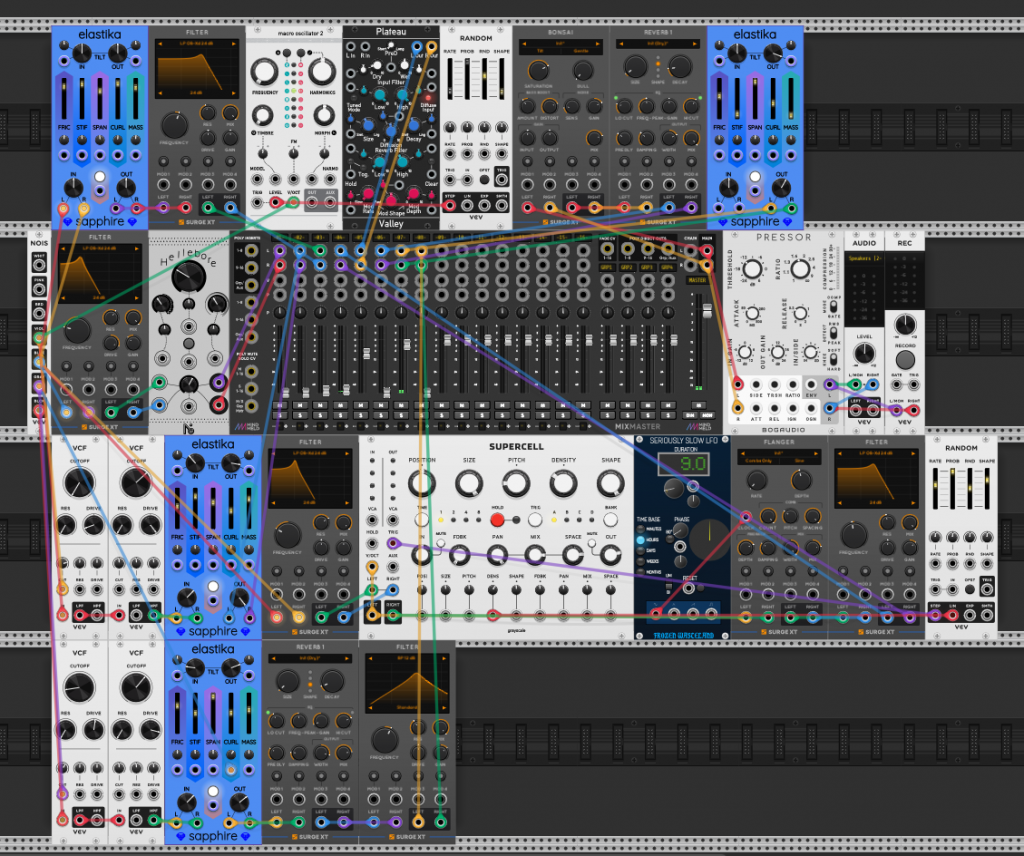
After that complete tangent, the method of this second patch is far more eclectic than the prior one, using similar techniques but with more experiments with taking modules I already like further.
A couple interesting things of note other than the techniques used in the prior patch, is the use of the flanger to add some subtle feedback (but with a rate low enough to not be rhythmic), the use of supercell for randomised stereo dispersion (with modulation from the Super Slow LFO, which allows you to have LFOs that last up to Months!). Another thing I tried is using the Macro Oscillator 2 to generate subtle plastic bass taps (it is unplugged here, but it was on during the session). The resulting sound reminds me of being lost ashore, making me think of Toilers of the Sea or of Donald Crowhurst’s endless voyage. There’s a lot of automation resulting from volatile modules and some feedback interaction (the whole mix is being sent back through Bonsai, which’s noise gate generates a lovely shuffling texture, which adds to the overall timbre).
I tried focusing this one on the stereo space a lot, taking influence from the very natural soundscape of Unser Verhängnis’ album Peace Is A Lasting Legacy When The Earth Is A Silent Grave, which is an album that I think has a very evocative and convincing post-apocalyptic soundscape whilst still remaining fixed within the falsehood of the static texturing realm. I tried mixing the Ambient track I did last week with this and it sounds really beautiful when the track is pushed way back, it gives the track a really solemn mood related to the imagined feeling of the space, projecting my own feelings onto it. I think retrospectively that it does feel a lot like what I know of Donald Crowhurst’s last race, silently leaving without a trace and leaving everything behind. I feel like I should see if I can watch a documentary so that I can include a sound bite between this track and the first one, possibly during the track or as an outro as well to give a further nod to Eugene Critchley & N0123Noise’s DNW format, as well as exercising a pretty long-standing interest in his story.

The most bizarre-sounding of the three so far, more exploration of Elastika, using it for stereo shuffling and wet organic trampling. I tried using Nucleus as well, which is another module by the same people that is supposed to distribute a sound source into particles, which you can then alter the density and speed of (similar to Elastika but a lot less wranglable for me). I got it to generate this kind of air resonance akin to an engine room, which is smothered with some really active, volatile Elastika layers (I really like the stereo on this one). I tried extending the technique of making the macro oscillator this subtle tapping layer, by adding a stereo delay with randomisation, making these mid-layer pops and hiss. I really like how the sound is evocative of this industrial space while having a weird wetness and occasional glitches. I sent it to a couple of friends to bounce some imagery off related to it, and my favourite was “ambient that sounds like an abandoned subterranean engine room.” Already, I’m not sure if the work is going to be “accessible” as a “Wall Noise For Dummies” work, but I think that it will maintain a broader appeal than just being for the probably couple of hundred people who care about this stuff.
As for Context, I want to keep my references separate to my research project, as both this and my research project are about Wall Noise, I don’t want all my references to be genre specific, I want to be more broad and thematic. So far I’m thinking about exploring Donald Crowhurst’s story and extrapolating from the prior mentioned albums, exploding their structures and using the technique mentioned in a Guest Lecture from Lynnée Denise prior about Album based Research, researching based on acknowledging how things sound, where they are from, who’s playing on the album, when was it recorded, what was happening at that time, etc (calling it DJ Scholarship, emphasising the role of a DJ as an Archivist), which is something I feel like I do already, I have dedicated a ridiculous amount of time listening to this style of music, so elaborating on the styles adjacent to and stemming from Wall Noise would be beneficial.